Protection from the AIs you never chose.
AI systems watch us, recognize us, track us and count us, often without our knowledge and without our consent.
AI Camouflage explores simple ways to shield ourselves from that automated gaze without ever hiding from one another: objects and patterns anyone can print, wear and build.
One direction: invisible to the machine, visible to the human.
Values
Fool the machine, never the human
The target is always an artificial-intelligence model. A face should remain a face, a licence plate should remain readable to a police officer, and a person should remain visible to other people.
Rebalancing power
An AI should not leave powerless the very people it observes, scores or decides to classify.
AI Camouflage develops ways to protect against automated systems that are intrusive, unfair or imposed.
These same techniques can also expose the flaws in legitimate systems: mastering them therefore helps companies, public institutions and states build AI that is more robust against adversarial attacks.
The goal is not to blind AI. It is to keep any single side from holding all the power.
Method
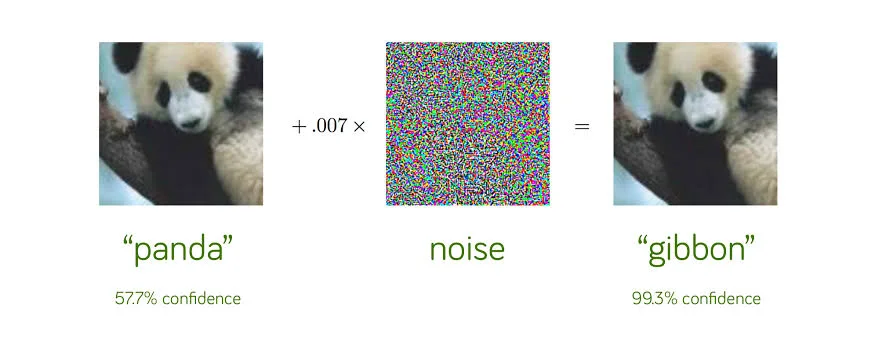
Most of the work presented here builds on adversarial attacks, also known as adversarial examples: subtle changes, often innocuous or nearly invisible, made to what an AI system receives as input, yet enough to make it fail.
A pattern printed on fabric, a frame fitted around an object, a texture applied to a surface: none of it keeps a human from understanding what they are looking at. But for a vision model trained to recognize a face, a plate or a silhouette, these details can change everything. Where a human sees an ordinary piece of clothing, a model may no longer detect a person.
Shall we try?
Want to become less visible to machines? Or test how robust your own AI is?
We have the first prototypes. What we lack are places to put them to the test.
It all starts with a conversation: yann.carbonne@proton.me